Enterprise UX
SIBOS attendees are senior banking and fintech professionals with limited time on the show floor. At a busy conference booth, they needed to quickly find relevant content—whether a case study, service overview, or video—without getting lost in complexity or committing to a long interaction. The challenge was not simply to make a large touchscreen look good; it was to capture attention, communicate EY’s payments expertise, and help users leave with information they could act on.
The experience also had to run entirely in Figma because there was no development budget, while supporting bilingual content and event staff working across time zones.
Key Achievements:
• Delivered a production-ready Figma prototype without external development resources, deploying it across two global events
• Led the localization strategy for APAC markets, coordinating asynchronous collaboration across Australia, China, and North America
• Architected a scalable component framework that reduced screen count and improved load times between the 2023 and 2024 builds
• Created deployment documentation that enabled non-technical staff to set up and run the experience on-site
Skills Used
Discovery
Because I had worked on the 2023 experience, I understood the existing flow and the team’s goals. For the 2024 version, new Figma features—including Local Variables and Advanced Prototyping—allowed us to reduce design debt and prototype bloat, cutting the delivery timeline from three months to one month. The project required approximately 60 hours of design work end to end.
The main challenge was meeting the project’s bilingual requirements while collaborating asynchronously with the client team overseas. We initially used Figma AI to translate key parts of the kiosk, then reviewed and refined the translations with the team to ensure accuracy.
Solution
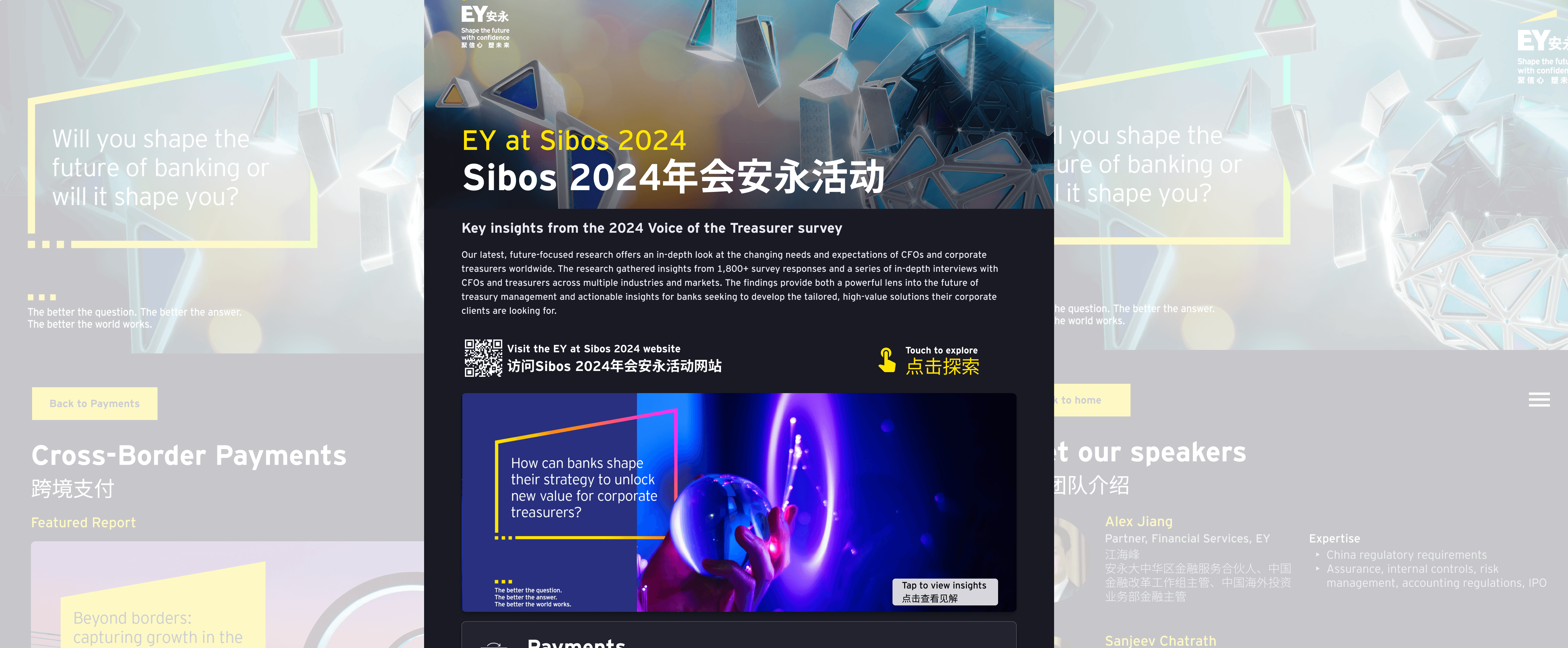
Developed a streamlined interface that simplified EY’s complex service offerings
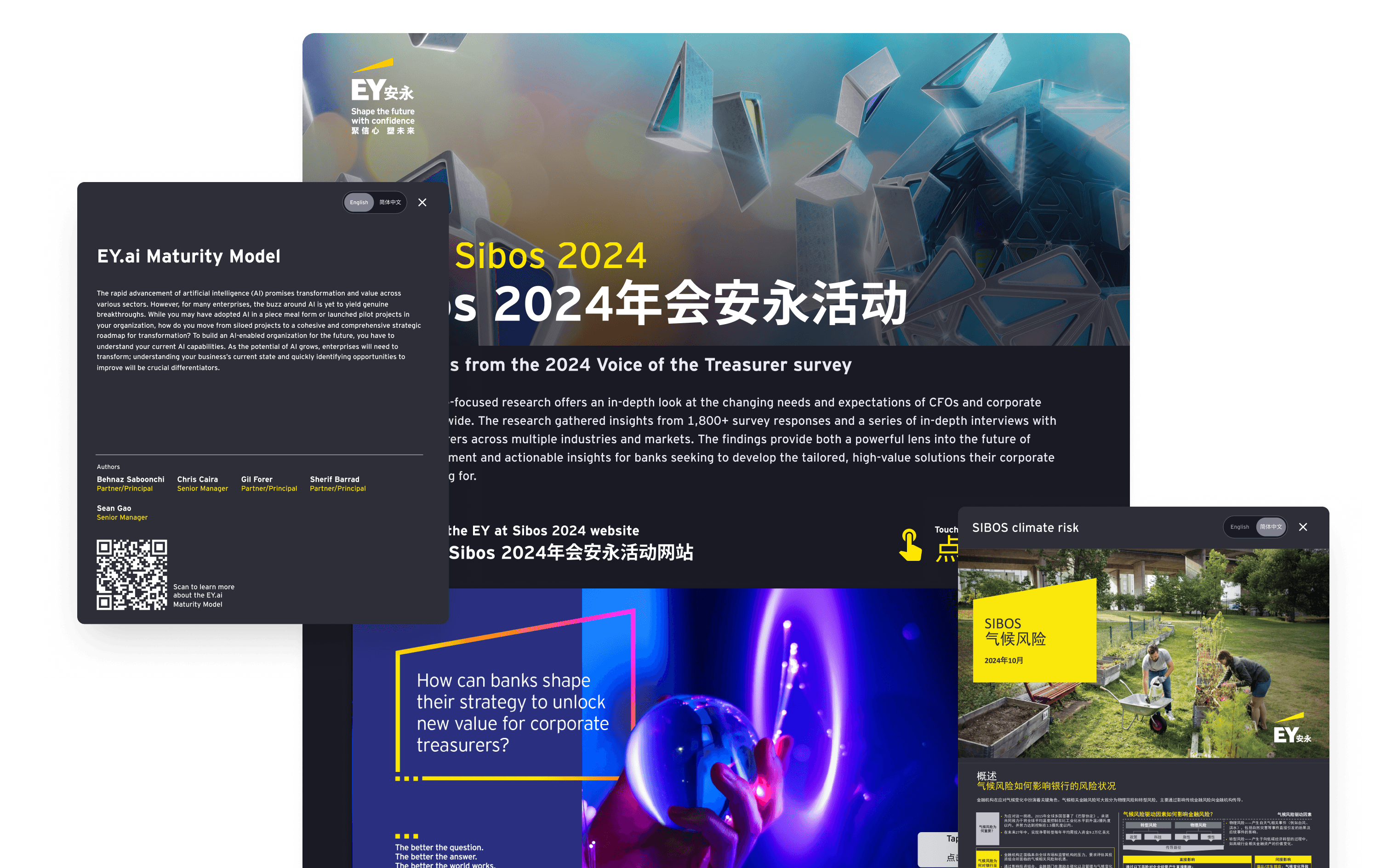
Used boolean Local Variables to control modal content from a shared base modal, allowing information to appear or hide as users interacted with each tile
Implemented bilingual functionality to support the event’s international audience
Resolved initial performance issues through Advanced Prototyping
Created comprehensive setup documentation for on-site implementation
Worked closely with colleagues in China to verify translations and account for cross-cultural design considerations.
Process
Used Local Variables and Advanced Prototyping to reduce prototype complexity and improve performance
• Designed a responsive layout for a large-scale touchscreen display
• Built a flexible interface that supported multiple language states
Outcome